Convergence Q45Equipped in stewardship
Restoring protected account continuity…

Primary research reviewed November 20, 2026

Follow the outcome.
Understand the comparison.

Read the journals, study populations, controls and actual effect sizes. The earlier complete evidence register is retained below.

Explore the practical stress guide

What a direct comparison found

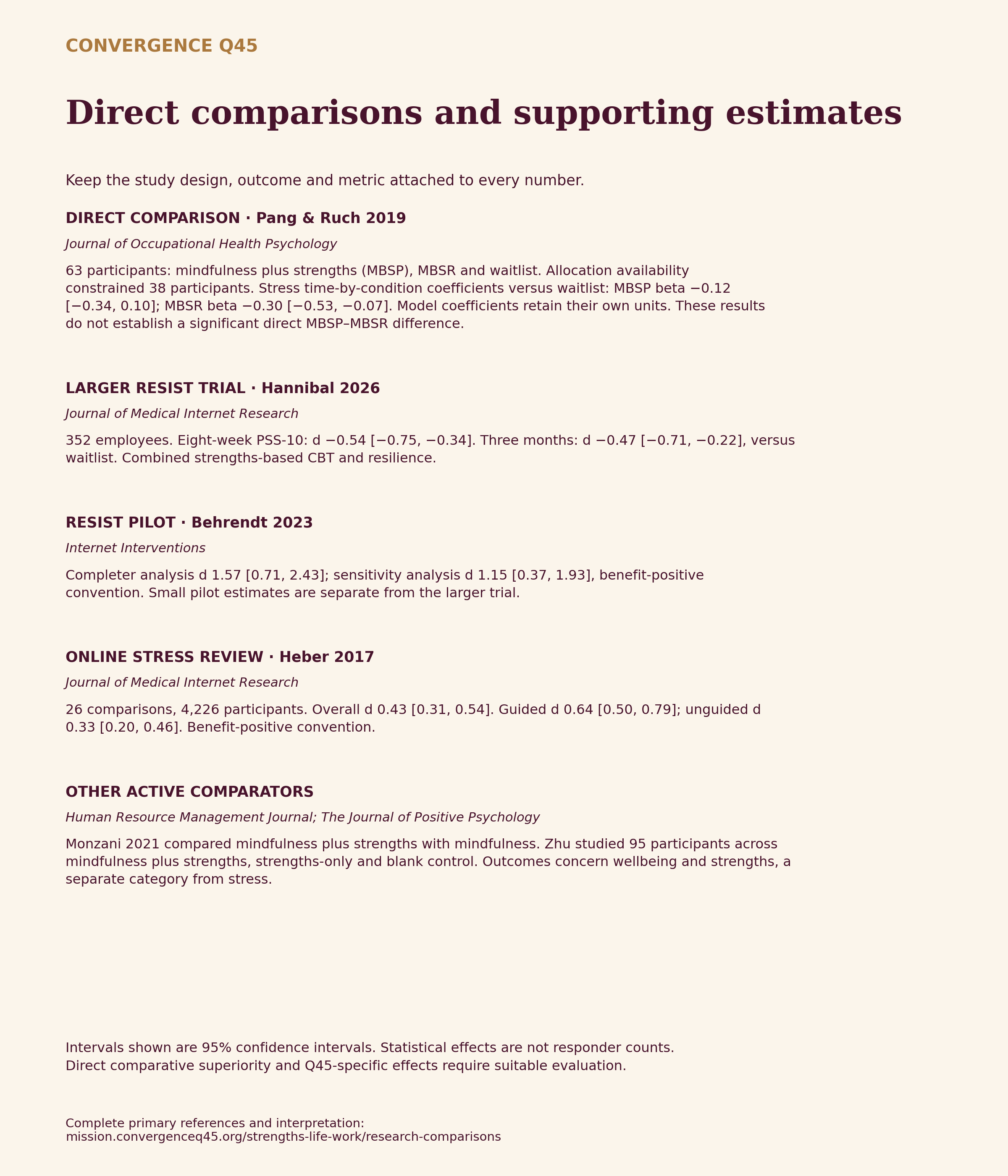
Pang and Ruch (2019), Journal of Occupational Health Psychology, compared mindfulness-based strengths practice (MBSP), mindfulness-based stress reduction (MBSR) and waitlist in 63 participants. Allocation was constrained by availability: 38 participants could attend only one intervention day.

Intention-to-treat time-by-condition stress coefficients versus waitlist were β −0.12 (95% CI −0.34 to 0.10) for MBSP and β −0.30 (−0.53 to −0.07) for MBSR. These mixed-model coefficients retain their model-specific units. A significant result in one group and an uncertain result in another does not establish a significant direct difference between them.

The study supports careful integration. Stress superiority from adding strengths remains unestablished; the strengths addition showed more promise for work outcomes.

Read Pang and Ruch, DOI 10.1037/ocp0000144

Other active-comparator studies include Monzani et al. (2021), Human Resource Management Journal, mindfulness plus strengths versus mindfulness, and Zhu et al., The Journal of Positive Psychology, MBSP versus strengths-only and blank control (95 participants). Their reported outcomes concern wellbeing and strengths, which belong to a separate outcome category.

Monzani et al. · Zhu et al.

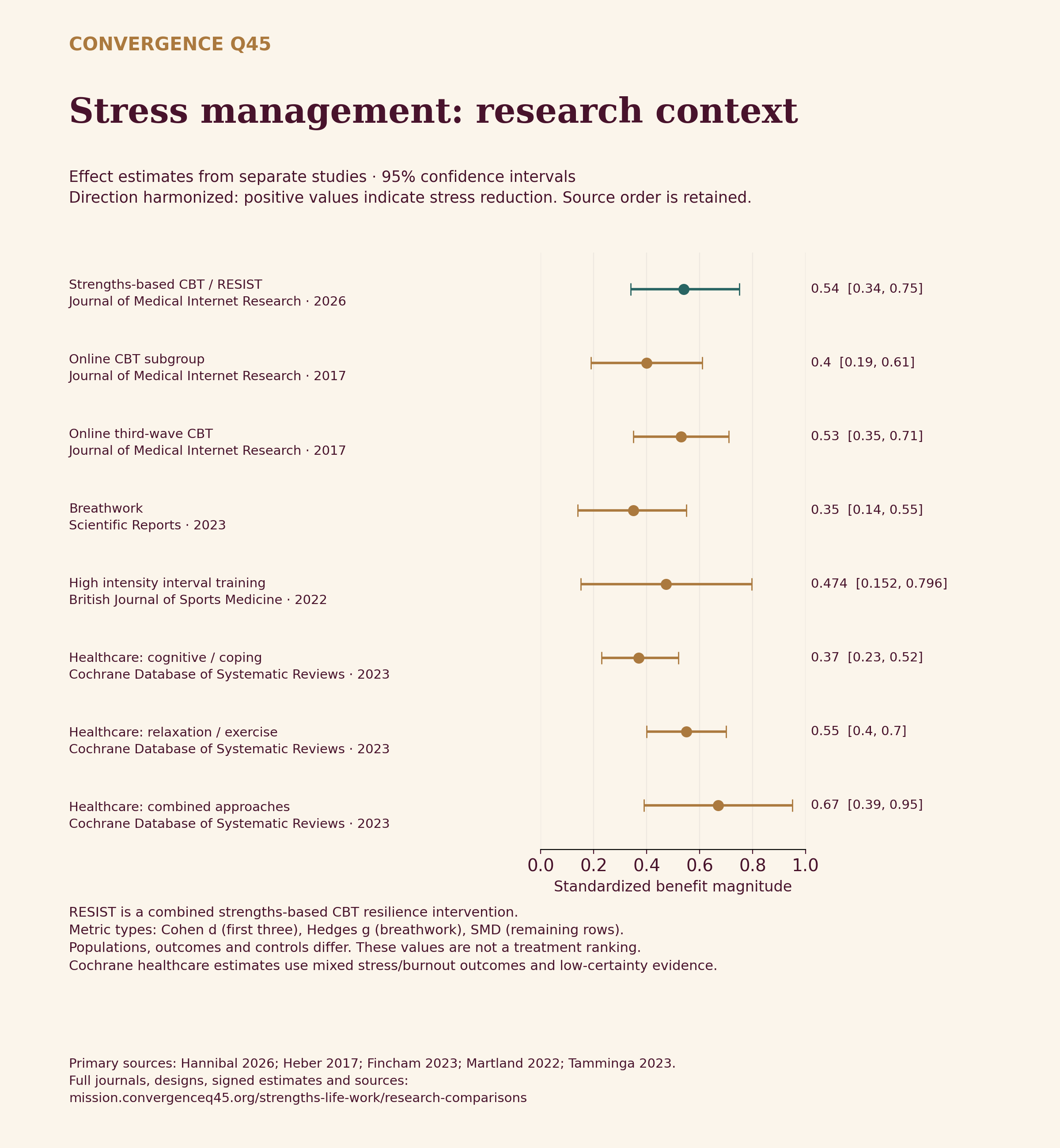
Stress effect sizes across studies

The estimates below provide context across separate studies. Different populations, outcome scales, controls, delivery and follow-up prevent a valid treatment ranking. RESIST combines strengths-based CBT and resilience methods; a pure strengths effect remains a separate question.

Strengths-based CBT resilience (RESIST)

Journal of Medical Internet Research · 2026

Design and population
352 employees; waitlist control
Outcome and timing
Perceived Stress Scale-10 · 8 weeks
Effect size
Cohen d: -0.54; 95% CI -0.75 to -0.34

Combined CBT and resilience program; the strengths component is not isolated. Three-month d −0.47 (95% CI −0.71 to −0.22).

Online CBT subgroup

Journal of Medical Internet Research · 2017

Design and population
6 comparisons within 26-comparison review
Outcome and timing
Stress · Postintervention
Effect size
Cohen d; benefit positive: 0.4; 95% CI 0.19 to 0.61

Different trials and controls from RESIST; indirect context.

Online third-wave CBT subgroup

Journal of Medical Internet Research · 2017

Design and population
13 comparisons within the review
Outcome and timing
Stress · Postintervention
Effect size
Cohen d; benefit positive: 0.53; 95% CI 0.35 to 0.71

Acceptance/mindfulness-related CBT category; individual components vary.

Breathwork

Scientific Reports · 2023

Design and population
12 randomized trials; 785 adults
Outcome and timing
Subjective stress · Postintervention
Effect size
Hedges g: -0.35; 95% CI -0.55 to -0.14

Various controls; most trials at moderate risk of bias.

High intensity interval training

British Journal of Sports Medicine · 2022

Design and population
4 perceived-stress studies
Outcome and timing
Perceived stress · Postintervention
Effect size
Standardized mean difference: -0.474; 95% CI -0.796 to -0.152

Inactive controls; activity should fit individual health and capacity.

Cognitive/coping interventions for healthcare workers

Cochrane Database of Systematic Reviews · 2023

Design and population
41 trials; 3,645 participants
Outcome and timing
Mixed stress/burnout symptoms · Short term, up to 3 months
Effect size
Standardized mean difference: -0.37; 95% CI -0.52 to -0.23

Low-certainty evidence; specific healthcare population and mixed measures.

Relaxation/exercise category for healthcare workers

Cochrane Database of Systematic Reviews · 2023

Design and population
35 trials; 2,366 participants
Outcome and timing
Mixed stress symptoms · Short term, up to 3 months
Effect size
Standardized mean difference: -0.55; 95% CI -0.7 to -0.4

Low certainty; category combines different techniques.

Combined approaches for healthcare workers

Cochrane Database of Systematic Reviews · 2023

Design and population
15 trials; 1,003 participants
Outcome and timing
Mixed stress symptoms · Short term, up to 3 months
Effect size
Standardized mean difference: -0.67; 95% CI -0.95 to -0.39

Low certainty; different interventions and populations prevent an efficacy ranking.

Research effect estimates and confidence intervals displayed in source order with population and method caveats.
Standalone raster research visual. Direction is harmonized to show stress reduction; source metric types remain labeled.

In the Heber review, the overall stress effect across 26 comparisons and 4,226 participants was d 0.43 (95% CI 0.31–0.54). Guided interventions: d 0.64 (0.50–0.79); unguided: d 0.33 (0.20–0.46).

A small RESIST pilot reported d 1.57 (0.71–2.43) in completers and d 1.15 (0.37–1.93) in a sensitivity analysis. The pilot's large and imprecise estimate is distinct from the larger 2026 trial.

Behrendt et al. (2023) · Internet Interventions

Keep different outcomes in view

The earlier strengths intervention workplace wellbeing estimate d 0.31 concerns wellbeing. The therapy coefficients β −0.23 to −0.54 describe observational stress associations. Each retains its own design and metric; Q45's program-specific effects require evaluation.

Direct comparison coefficients, larger trial, pilot and review estimates with journal names and design limits.
A separate individual reference image.

Every earlier source,
with its journal.

Complete earlier evidence register, with journals added
Topic and paperJournal / publicationEvidence and scope
SleepJackowska et al. (2016; online 2015), The impact of a brief gratitude intervention on subjective well-being, biology and sleepJournal of Health Psychology119 young women; two-week randomized gratitude trial. Reported sleep quality, optimism and wellbeing improved. Brief follow-up and a specific population limit generalization.
Energy and stressWood et al. (2011), Using personal and psychological strengths leads to increases in well-being over timePersonality and Individual Differences207 adults assessed at baseline, three and six months. Strengths use predicted greater vitality, positive affect and self-esteem, and less stress. Observational longitudinal evidence.
Daily stress and energyGallup (2012), When Americans Use Their Strengths More, They Stress LessGallup provider report5,049 US adults. Stress: 52% with strengths use 0–3 hours/day versus 36% with 10+ hours/day; gap 16 percentage points. Sufficient energy was 22 percentage points higher in the 10+ hour group. Observational; these exposure categories are not a prescribed dose.
Stress during therapyStrengths use and emotional disorder symptom reduction during a transdiagnostic cognitive behavioral therapy (2025; online 2024)Psychotherapy120 therapy participants. Subsequent stress associations: standardized β −0.23 to −0.54. Strengths exposure itself was not randomized.
PeaceChérif, Niemiec and Wood (2022), Character strengths and inner peaceInternational Journal of WellbeingStudy one: 25,302 perceptions respondents. Study two: 21,201 strengths/peace respondents. Hope had the strongest association; zest and gratitude also stood out, with spirituality and forgiveness secondary. Cross-sectional.
Cancer supportive careYan et al. (2026; online 2025), Character Strengths-Based Intervention for Enhancing Self-esteem and Quality of Life and Alleviating Depression in Female Patients With Breast CancerCancer Nursing122 women; 61 per active study group. Improvements in quality of life, self-esteem and depressive symptoms immediately and at one month. Cancer prevention, recurrence and survival benefits remain unestablished.
Cancer contextNational Cancer Institute, Stress and CancerNCI fact sheetStress and cancer incidence findings are mixed. Stress management supports coping; the evidence does not establish strengths practice as cancer prevention or a survival treatment.
Heart careBlumenthal et al. (2016), Enhancing Cardiac Rehabilitation With Stress Management TrainingCirculation151 participants; median follow-up 3.2 years. Events: 18% with rehabilitation plus stress management versus 33% with rehabilitation alone. HR 0.49; 95% CI 0.25–0.95. This tested stress management within rehabilitation.
Health behaviorsHuffman et al. (2019), Positive Psychology–Motivational Interviewing After an Acute Coronary SyndromeAmerican Journal of Cardiology47 participants; approximately 1,842 additional steps/day at 12 weeks and 15.1 additional moderate to vigorous activity minutes/day at 24 weeks. Small multicomponent trial.
Business outcomesGallup, Strengths-Based Employee Development and Organizational OutcomesGallup provider report43 studies, 22 organizations, approximately 1.2 million employees, 49,495 business units, 45 countries and seven industries. Estimated sales +10.3–19.3%; profit +14.4–29.4%; engagement +9–15%. Provider utility estimates; individual salary and Q45 effects require separate evaluation.
WorkVîrgă et al. (2023; online 2022), Effectiveness of strengths use interventions in organizationsApplied Psychology21 independent controlled trials. Immediate performance d=0.28 (95% CI 0.11–0.45); wellbeing d=0.31 (0.21–0.41); follow-up performance d=0.22 (−0.15 to 0.59), uncertain. Standardized effects retain their statistical units.
Employee empowermentHo and Kong (2016), A self-determination perspective of strengths use at workThe Journal of Positive PsychologyMatched observational data from 194 employees and their supervisors linked autonomy support, strengths use, task performance and helping colleagues.
Manager coachingTobias et al. (2024), Coaching Based on Signature Strengths or Lesser Strengths?Journal of Happiness Studies255 managers randomized between two active strengths spotting approaches. Self-reported coaching improved at one month in both groups; an untreated control was absent.
ImplementationWatermann et al. (2026), AI-Based Reflection on Character Strengths at WorkInternational Journal of Applied Positive Psychology111 working adults; AI-supported reflection, self-reflection and waitlist. No clear intervention effects on primary outcomes, including strengths use, wellbeing and engagement.
Related productivity evidenceBellet, De Neve and Ward (2024; online 2023), Does Employee Happiness Have an Impact on Productivity?Management ScienceBT call-center research observed happiness and sales over six months, using local weather variation as an instrument. Related happiness/productivity evidence; strengths and peace were not isolated.

Turn evidence into a thoughtful practice.

Build my application plan